09/15/15

Curiosity, talent, duty, reinforcement

Naomi Oreskes on why people become scientists:

Well, the idea that scientists are in it for the money is idiotic, because scientist are all intelligent people and if they wanted to make money there’s a lot of better things they could do…

[. . .]

Why do people become scientists? I think it’s a mix; I think there are different things. I think that a lot of scientists are just naturally curious people—there’s what we could call the “natural historical” scientists, the people who like to collect rocks and bugs and things, and I was one of those, y’know, kids who have rock collections, right? So a lot of geologists had rock collections when we were kids. So, I think those are the sort of “curious about the world around them” types.

Then there are people who go into science because they’re really good in math. If you are talented in math, there’s a lot you can do in science. There are a lot of problems in the world that, if you have quantitative skills, you can address those things in ways that other people can’t. So, math is a powerful toolkit, and if you have that toolkit, science is a great place where you can use it.

Some people go into science ’cause it’s what they’re good at. Y’know, it’s what Jim Hansen says, he says, “I went into science ’cause I was good at it.” It’s where their talents lie. So they don’t necessarily collect bugs as kids, but they do well in science in school, and then they get encouraged because a lot of people can’t do science.

And to some extent that’s what happened to me, too. When I was a girl growing up, I was good in science, but I was good in a lot of other things, too. But being good at French or English didn’t seem special; being good at science did. And people— I mean, I had teachers who said to me explicitly, “Y’know, if you can do science, you have to.” And in hindsight, that seems actually a little weird, when you think about it, but remember, I’m also the Sputnik generation, right? We were raised to think that it was almost a kind of national duty, a patriotic duty, to go into science if you could. And then as a girl of a certain age—I’m just old enough that there was a kind of gender incentive to go into science, that science was just beginning to open up to women—and so there was this feeling that if you could do science and you’re a woman, you absolutely should, y’know, science needs you, the world of science needs you.

So there was a lot of positive reinforcement to go into science, and I think lots of people in science got that positive reinforcement…

This is an absolutely wonderful interview with Naomi Oreskes, co-author of Merchants of Doubt. This part is near the end of the interview, but the whole thing is highly worth seeing. She recounts how she started out as a geologist, then became a historian of science, and one day discovered she was being attacked on the floor of the Senate by James Inhofe (R-OK). As she says, the job of a historian of science is to understand science in its social context, so when she began being attacked in very bizarre ways by people with clearly political motives, her natural response was to try to understand why they were doing this.

The result of that investigation is Merchants of Doubt, which details the history of the anti-science propaganda machine first created by tobacco companies in the 1950s to undermine public confidence in the growing scientific evidence of the dangers of smoking, and was then repurposed in the 1980s and ’90s to undermine the science of how carbon dioxide emissions from the burning of fossil fuels is destabilizing the earth’s climate.

The video is part of Making Sense of Climate Science Denial, a free MOOC put together by John Cook and the folks at Skeptical Science, and hosted at edX. The course examines the psychology of climate science denial, the basics of climate science, the physical evidence that the earth actually is warming, and how to effectively counter the misinformation put out by the denial machine.

The course videos are all available on YouTube, as well as at edX. Very much worth watching.

06/1/15

Emulating arrogance

“Look, first of all, the climate is changing,” Bush said. “I don’t think the science is clear of what percentage is man-made and what percentage is natural. It’s convoluted. And for the people to say the science is decided on this is just really arrogant, to be honest with you.”

Jeb Bush, 20 May 2015

Sigh. Actually, no. The scientists who study this have been quite clear, and so has the natural world.

Carbon dioxide interferes with the ability of the earth to radiate into space the heat it receives from the sun. This is what so gratefully keeps temperatures around the world from being like the airless moon that reaches a daytime high around 240F (116C, 390K), with a nighttime low of -280F (100K, -173C). The CO2 in our air (helped along by the humidity that’s only there because the carbon dioxide keeps things warm enough that it doesn’t all freeze out) greatly reduces those extremes, but not by the same amount; our days are cooler than the moon’s, but our nights are warmer by a lot. The more CO2 there is, the greater that effect, so that typical highs and lows not only go up, they get closer together, too, and overall, the whole world warms.

By dumping billions of tons of carbon dioxide into the atmosphere every year, we’re heating up the world. We know that because we are directly measuring atmosphere and ocean temperatures, and measuring incoming and outgoing radiation from satellites in orbit. Together these tell us the earth is now radiating less heat into space than we receive from the sun. (This, by the way, is what they mean when they talk about positive radiative forcing. The world is getting hotter because we’re radiating less heat to space than we used to, and that forces the climate to change.)

On these basic facts, among working climate scientists, there is no significant dispute.

Warming of the climate system is unequivocal, and since the 1950s, many of the observed changes are unprecedented over decades to millennia. The atmosphere and ocean have warmed, the amounts of snow and ice have diminished, sea level has risen, and the concentrations of greenhouse gases have increased.

Each of the last three decades has been successively warmer at the Earth’s surface than any preceding decade since 1850.

Ocean warming dominates the increase in energy stored in the climate system, accounting for more than 90% of the energy accumulated between 1971 and 2010.

The atmospheric concentrations of carbon dioxide, methane, and nitrous oxide have increased to levels unprecedented in at least the last 800,000 years. Carbon dioxide concentrations have increased by 40% since pre-industrial times, primarily from fossil fuel emissions and secondarily from net land use change emissions. The ocean has absorbed about 30% of the emitted anthropogenic [human-caused] carbon dioxide, causing ocean acidification.

Human influence has been detected in warming of the atmosphere and the ocean, in changes in the global water cycle, in reductions in snow and ice, in global mean sea level rise, and in changes in some climate extremes. This evidence for human influence has grown since [2007]. It is extremely likely that human influence has been the dominant cause of the observed warming since the mid-20th century.

Human influence on the climate system is clear. This is evident from the increasing greenhouse gas concentrations in the atmosphere, positive radiative forcing, observed warming, and understanding of the climate system.

—IPCC Fifth Assessment Report, Working Group 1 Summary for Policy Makers (PDF, 2.3MB)

I understand your not wanting to contradict the carefully manufactured misconceptions Republican voters now have of how the world works, but Jeb, seriously, taking your talking points from Sen. Inhofe? So not cool…

Sen. James Inhofe (R-OK), with the unshakable certainty of a man convinced he knows, beats the donkey who repeatedly warned him of a danger in their path that he can’t see. Nearby, two women gaze at each other in astonishment.

Sen. Inhofe reads Genesis 8:22, “As long as the earth remains there will be springtime and harvest, cold and heat, winter and summer, day and night,” as saying human actions can’t change global temperature or the timing of the seasons, and then proclaims it arrogant to think we could. Maybe he finds it comforting to read that into it, but it only says those pairs of things will always be here. It doesn’t say crops will forever grow where we have long grown them or in the amounts we expect and need, that patterns of heat and cold will always remain the same, or that the timing of new growth in spring or leaf-fall in autumn will never change.

The passage the senator quotes comes at the end of the flood narrative, immediately following God’s promise in Genesis 8:21, “Never again will I curse the ground because of humans… And never again will I destroy all living creatures, as I have done.” But He doesn’t say we can’t mess with the world to our peril, that He will protect us from the consequences of what we recklessly choose to do.

Nevertheless, the senator is confident he knows what we “can’t” do.

As Oxford Dictionaries puts it, arrogant means “having or revealing an exaggerated sense of one’s own importance or abilities”. In contrast, there is a genuine confidence, in one’s abilities and understanding, that comes from years of practicing science, of listening to the natural world, observing it closely, letting go of certainties immune to evidence, and allowing one’s understanding to deepen as the natural world itself teaches us its nature.

04/21/15

When the Mediterranean became once more a sea

The Mediterranean . . . it’s got these couple of problems. It’s a respectable-sized sea, y’know; it covers an area of 970,000 square miles (2.5 million square kilometers). That much surface area, you get a lot of evaporation. Now, that’d be ok, I mean, some of it rains back in, some comes back in rivers, but the thing is . . . it doesn’t rain all that much . . . relatively speaking. And the rivers that feed into it, they’re a bit on the wimpy side . . . relatively speaking. All appreciation to the Nile for its awesomely important history and everything, but it ain’t no Amazon.

So that’s problem number one. Problem number two: the Earth is molten inside. More specifically, what we call the Earth’s crust—land and ocean bottom—is mostly a thin skin of solid rock floating on melted rock that’s ever-so-slowly churning this way or that, taking big floating hunks of crust with it wherever it happens to be going. Hunks like Africa. Africa’s been floating north-easterly for a while now; a few million years, in fact. So, not very fast, but fast enough to become a problem. Because, y’know how that Straight of Gibraltar is kind of narrow? All it’d take would be for Morocco to hook up with Spain, close the straight, and guess what? Way more water evaporating into the sky than comes back in through rivers and rain. Let that go on long enough, whadda you think’s gonna happen? Thing is, it actually has. More. Than. Once.
Continue reading

11/30/12

Things that would make even Dickens go “hmmm…”

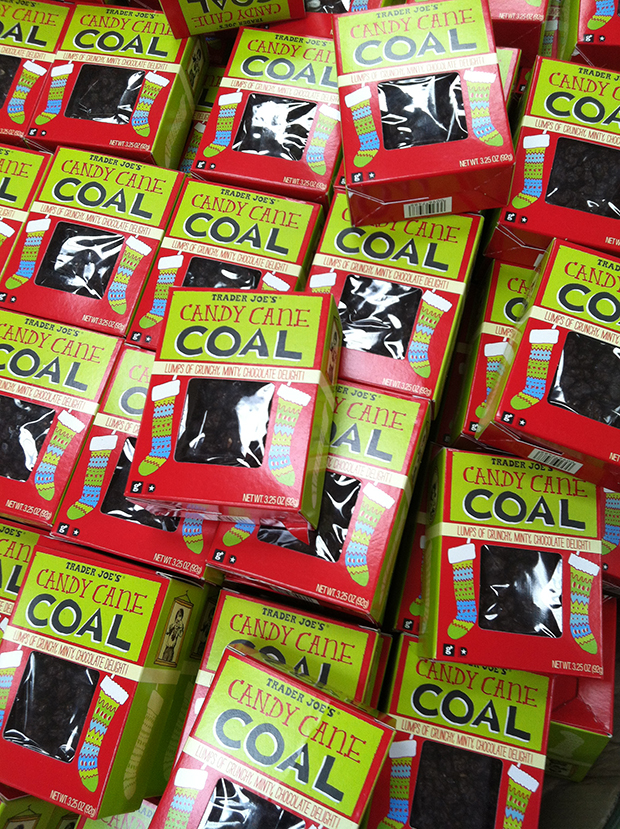
Candy CoalHaving just finished Joe Romm’s excellent new book, Language Intelligence: Lessons on Persuasion from Jesus, Shakespeare, Lincoln, and Lady Gaga on the myriad uses of the techniques of rhetoric, I momentarily thought to title this post “Christmas Candy Coal Stocking-Stuffer: Naughty, Not Nice,” but just couldn’t get it past my gag reflex. In any case, I don’t know whether this is a now-classic holiday candy that I just never noticed before, being not inclined these days to frequent that particular supermarket aisle, but the galvanized steel tub brimming with boxes of it right at the check-out line in Trader Joe’s yesterday was impossible to miss.

In fact—as I’ve since learned—if you web search “candy coal” you’ll find a ton of it, from chunky mint chocolate candy coal, to chunky hard licorice candy coal (comes with its own Victorian-style hammer, for the experience of breaking it into yet smaller chunks!), to recipes for how to make your own, and a lot of ads referring to the traditional “If you kids don’t behave you’ll get a lump of coal in your stockings for Christmas, instead of presents!” right before noting how sweet the stuff is when made from dark chocolate instead of compressed carbon. That’ll teach ’em.

At a younger, more naive age, I might’ve gone oh… hmmm… cute, I guess, but whatever. Pardon my rather distinct lack of trust on this, but these days, with our fossil-fuel-driven massively uncontrolled chemical experimentation on the atmosphere leading to ever greater climate disruption, with Naomi Oreskes’ Merchants of Doubt: How a Handful of Scientists Obscured the Truth on Issues from Tobacco Smoke to Global Warming racketing around in my brain, with the Sierra Club’s Beyond Coal campaign to replace dirty coal-fired power plants with clean renewable energy, Bill McKibben’s Do The Math tour promoting divestment from fossil fuel interests, politicians afraid to use the word climate (unless they’re the sort who attack the scientists and the science), and ever-more-aggressive pushback from the coal and oil industries, it’s a very different hmmm… indeed.

Yes, of course I’d love some Candy Coal! And could I please have some Light Sweet Crude Maple Agave to go with that? Perfect!

Yeah, right. I need a candy cigarette.

11/30/12

Cycles: Look! It’s our planet breathing!

As often as we hear these days how the Earth’s climate is warming due to all the carbon dioxide we’re pouring into the air by burning fossil fuels, I thought it’d be worth mentioning that until a few weeks ago the concentration of CO2 in the atmosphere had been falling rapidly for months. In fact, it started to fall in late May, and continued to do so all through summer and into autumn, finally slowing down in October. By now, the amount of CO2 in the air is increasing again.

But actually, it does this every year. What’s going on?
Continue reading